
Shame & the Algorithm.
The Shadow Code you need to know about

“Everyone carries a shadow, and the less it is embodied in the individual’s conscious life, the blacker and denser it is.” — Carl Jung, Psychology and Religion (1938)
This essay argues that shame - one of the deepest and most embodied human emotions- cannot be read or encoded by machines. Shame has no fixed physiological signature; it moves through people as withdrawal, silence, rumination, confusion, or dissociation. And often leaves no visible trace at all.
AI systems, built on surface signals and pattern recognition, can only register what can be seen or categorised, which means they are fundamentally incapable of perceiving what shame actually is.
And yet algorithms increasingly amplify the very conditions in which shame flourishes, from status anxiety to social comparison to the performance of identity online. The gap between what machines can recognise and what they actually provoke is the central tension this essay explores.
1. Shame Cannot Be Coded
What is the best thing to do with a past that refuses to be repressed? What to do when the skeletons come tumbling out of the cupboard?” Salman Rushdie, Shame (1983)
We always think of Shame as cultural. Salman Rushdie opens Shame (1983) with an infant girl left outside a house. Unwanted and abandoned. She grew up never speaking of her origins, because there are no words that would not compound the disgrace.
But Shame inhabits each of us in big and small ways.
As a person of indecipherable and entangled cultures, I can tell you that Shame is part of all of our lived experiences. I found this whole post very hard to write.
Honour killings come from shame. Our Western judicial systems operate in large part on social shame. Shame leads many people into social or emotional isolation. Shame is seen as a lever - a counterbalance to Ego, a way of keeping our instincts in check.
A bad performance review at work. A wife who leaves you for someone you know. A bank balance that gives you anxiety every time you look at it. Owing someone money. Standing alone in a corner at a party, feeling like you don’t belong. Looking in the mirror and hating your own reflection. Being unable to kick that unhealthy habit. Carrying the wounds of sexual abuse. Being pulled to the side at airport security because of your last name. Being betrayed by someone you loved.
Those who fail to recognise their own shame often become destructive to themselves. To society. To their loved ones.
In our bodies and in our sexuality. In work and in life. In love and very often, of course, in war, we face shame. We are not often able to be vulnerable in confronting our own demons, our sense of self, and the persistent, grating sense of failure or smallness.
Psychologists define shame as a self-conscious emotion involving a global negative evaluation of the self.
Shame operates across every dimension of human experience: it lives in the body, shapes the mind, wounds the spirit, regulates social behaviour, and passes through generations.
Unlike guilt, which focuses on a specific behaviour, shame involves the entire self as the object of judgement. It requires a sense of falling short of standards that matter.
Shame triggers an automatic bodily response before conscious thought.
It often enters the body as a kind of shock: something unexpected happens faster than we can process it. And when that shock isn’t metabolised, it doesn’t become memory or understanding; it becomes residue, shaping our reactions long before we have language for what we felt.
But shame is also slow-moving and comes from experiences and thoughts we carry throughout our lives and beyond our individual selves. For many people, it is impossible to either recognise or lift most sources of Shame. In a way, it is a silent collaborator on many of our journeys. And ironically, we all have it. It is inherently human.
Very often, shame doesn’t linger as a singular feeling. It translates into other emotions we are more familiar with. Rage or anxiety. Grief or insecurity. It can manifest as attention-seeking or aggression.
Traumatic memories are stored as fragments of sensory experience: sounds, images, physical sensations, rather than coherent narratives. They are very difficult if not impossible to articulate.
Psychiatrist Bessel van der Kolk documents in The Body Keeps the Score (2014) how survivors of childhood abuse often cannot access verbal memory of what happened to them, even decades later. The experience was encoded before language was available to process it. It surfaces as panic attacks, dissociation, and physical symptoms: reactions that happen to the person rather than stories they can tell.
Machine rationality, all of it stemming from mathematics, science, and now AI, operates through structure and explicit representation. These two modes don’t oppose each other, but they organise experience differently. Shame cannot be coded.
So, in this age of machine intelligence, I’d say that shame is inherently human.
And just like many people outside your own head, machines can’t recognise this feeling. Very often, it is because we don’t have the emotional or cultural tools to acknowledge or articulate it.
If you are wondering about other species: Animals show some of the bodily behaviours that resemble shame, such as gaze aversion and a lowered posture, but these are submission responses, a different experience. There is no evidence that non-human animals possess these capacities.
2. Embodiment
Shame lives first in the body. The flushing of someone’s cheeks or averted eyes and dropped gaze. Slumped shoulders or the physical shrinking - these are the body’s part of the experience of shame.
Phenomenology, the study of experience from the inside, has long understood shame as a bodily event. It’s plausible that young children - toddlers or preschoolers - can experience something akin to shame.
As children develop, they begin forming global judgements about themselves: not just “I did a bad thing” but “I am bad.” Research shows this pattern predicts depression later on, because shame is not about a single action but about the whole self feeling deficient.
Congenitally blind athletes, people who have never seen another human being, produce the same shame responses to defeat as sighted people. Psychologists Jessica Tracy and David Matsumoto (2008) studied competitors at the Paralympic Games and found that when athletes lost, both blind and sighted showed slumped shoulders or narrowed chest.
No one taught the blind athletes this display. The response to disappointment or loss is wired into the body.
Mapping Shame is very difficult
This is because the body does not always display what is inside.
Mental illnesses like schizophrenia can produce flat affect: barely any external display while the subjective experience remains fully intact. People hide their emotions purposely. Job interviews, first dates, family dinners, police encounters: social life demands constant modulation of what we show.
Shame is “the affect that dare not speak its name.” Psychoanalyst Peter Fonagy’s work on mentalisation shows that early relational trauma impairs the capacity to represent one’s own mental states in language. The shame is felt but cannot be thought.
The body keeps what cannot be spoken. Trauma encodes itself beneath language, in muscle, in breath, in posture. It surfaces when a smell or a sound triggers it, not when you choose to recall it.
In girls with complex PTSD, the insula, the brain region that processes how the body feels from the inside, shows premature ageing. The body does not just remember. It wears down from carrying what cannot be put into words.
Under surveillance, this concealment intensifies. When people know they are being watched by cameras or employers monitoring their keystrokes and expressions, they become hesitant to display anything authentic. The watched self is not the felt self.
And sometimes the exterior is simply disconnected from the interior. Trauma can sever this link. Dissociation, depersonalisation, or more simply emotional numbing: these are common responses to overwhelming experience. Someone smiling at you may actually be feeling nothing at all.
The distinction between shame and guilt is crucial.
Guilt targets a specific action (”I did a bad thing”); shame targets the self (”I am bad”). Psychoanalyst Helen Block Lewis established this distinction in 1971. Guilt can be resolved through apology or restitution. Shame cannot, because there is nothing specific to fix.
And this is why shame resists articulation. Patients in psychotherapy would often become “tongue-tied” or fall into confused, fragmented speech when shame arose, even when they could speak fluently about guilt. Lewis called this the “wordless” quality of shame.
3. Culture
Sacred architecture: Humans have always created physical metaphors for the interior. Sacred architecture - in many cases in ancient times containing the core interior, known as holy of holies - is protective of the deepest parts of our being. Ancient temples were built as a sequence of spaces - public courtyards, inner rooms, and a veiled inner chamber accessible only to one person. The self works the same way.
The body carries not only its own history but inherited history: Psychologists describe this as intergenerational trauma. African American communities carry the legacy of centuries of dehumanisation. Descendants often inherit patterns such as hypervigilance, body-surveillance, fear of punishment, or overperformance as a form of protection. In these cases, what looks like shame is actually trauma passed down through generations.
The ancient Greeks had aidos: shame, modesty, and respect all at once. In Homer, aidos was the cement of society. Not purely negative: the sense of how one appears to others and to oneself, felt in the body. The Greeks personified it as a goddess, and when she withdrew, humanity became reckless.
Christianity took a different path. Many religions have adopted this ultimately poisonous thread.
In the biblical story, shame first entered the world after Adam and Eve ate the forbidden fruit, causing them to feel ashamed of their nakedness for the first time. Before this act of disobedience, they were naked but felt no shame or need to cover themselves. After sinning, their eyes were “opened,” they felt exposed, and they immediately used fig leaves to sew coverings for themselves. Sexuality became the primary site of shame. The body became a problem to overcome, not a place to inhabit.
Indigenous traditions often understood the body differently. Before colonisation, many cultures integrated body, land, community, and spirit - shame was seen through a collective lens. In many pre-colonial Indigenous societies, social order was maintained through complex kinship systems and relational accountability. An individual’s actions, whether positive or negative, reflected upon their extended family and community.
Colonisation fragmented this integration. Shame as a concept has similar causes in individuals but is presently liked to the desecration of their own heritage. Children in residential schools were taught to feel ashamed of their language, their practices, and their skin. In Aboriginal English, “shame” has a broader meaning: it can be triggered by attention itself, not just wrongdoing.
In Arab culture, karam (generosity) carries sacred weight. Failing to provide for a guest brings shame upon the host. The shame is relational: it falls on the one who cannot give, not the one who receives nothing.
In the West, middle-aged men carry a different silence. When they cannot fulfil the provider role, shame turns inward. They are the group most likely to die by suicide. Perhaps to generalise, the shame has no ritual, no community to hold it.
Today still, shame is not just felt individually. It is produced and enforced collectively.
Shame regulates behaviour. Communities use it to mark what is acceptable and what must be hidden. The threat of exposure or exclusion keeps people in line.
Institutions formalise this regulation. Schools’ grade and rank. Workplaces review performance publicly. Welfare systems require applicants to prove need, often in humiliating ways.
Shame has been weaponised to “punch down” at vulnerable people, blaming individuals for systemic problems rather than addressing institutional failures.
Mathematician Cathy O’Neil makes this argument in The Shame Machine (2022). Her key distinction: shaming someone who cannot conform, or who has no voice, is not correction. It is bullying.
Digital platforms amplify and accelerate this process. A mistake that once stayed local can now circulate globally within hours. We perform shame. We lob it at other filter bubbles. Algorithms are optimised to serve what arouses us most, which is usually outrage.
If you feel triggered reading this or feel you need help - there is always support: https://www.nhs.uk/mental-health/feelings-symptoms-behaviours/behaviours/help-for-suicidal-thoughts/
4. Biology
“The face is not a window to the soul. It is a billboard.”, psychologist Paul Ekman.
What if you try to hide shame?
A review of over 1,000 studies on facial expression and emotion, found that “There is no reliable mapping between facial configurations and emotional states.” Neuroscientist Lisa Feldman Barrett at Northeastern University, reached a clear conclusion: The six basic emotions that most AI systems are trained to detect (happiness, anger, sadness, fear, disgust, surprise) are not “natural kinds” with stable biological signatures.
Barrett writes: “Emotions are not triggered; they are made.”
Autistic individuals often display atypical facial affect while experiencing emotions as intensely as anyone else. A facial recognition system trained on neurotypical expressions will systematically misclassify autistic people.
“You can suppress your expression, but the autonomic nervous system still fires: heart rate increases, cortisol rises, facial temperature increases, muscles tense, and posture micro-contracts. You can hide the display, but not the reaction.” (Ekman 2004; Ioannou 2017; van der Kolk 2014).
Shame produces measurable physiological responses, but they are neither specific nor reliable. AI can register surface signals, but it cannot interpret them, because shame has no fixed signature, and its real damage occurs in the interior self, not in the data.
Social rejection activates the anterior cingulate cortex, the same brain region involved in physical pain. Research by Naomi Eisenberger and Matthew Lieberman (2003) showed that the brain processes social exclusion using the same neural architecture it uses for physical injury.
Being humiliated does not just feel like injury. To the brain, it is injury.
When a person experiences shame, the body shows increased heart rate and elevated cortisol.
Thermal imaging reveals that facial temperature rises: the blush is not just visible to others but physically measurable.
People prone to shame tend to replay painful events, ruminating in ways that reactivate the physiological response.
Studies show this pattern increases the risk of depression, because shame creates a feedback loop between body and mind that reinforces itself.
The relational nature is key. Shame arises from a sense of scrutiny or ridicule by people perceived as more powerful: parents who express contempt or disgust, peers who exclude, and authorities who judge.
5. Intimacy & Identity
“The practice of love offers no place of safety. We risk loss, hurt, pain. We risk being acted upon by forces outside our control.” bell hooks, All About Love.
In intimate relationships, shame becomes a weapon.
Numbers cannot capture the moment dissatisfaction becomes shame: the turn inward, the belief that the problem is you. They cannot measure how shame surfaces as avoidance, obsession, silence, or rage turned inward.
Nearly half of both women and men have experienced psychological aggression from an intimate partner. But the patterns differ. Women are more likely to experience coercive control: the systematic erosion of autonomy through gaslighting, isolation, silence and humiliation. Thirty per cent of women experiencing intimate partner violence are subjected to this pattern, compared to six per cent of men.
Coercive control operates through shame.
The abuser makes the victim doubt her own memory, her own reality. She is told she is “crazy,” “too sensitive,” “imagining things.” Isolation cuts her off from anyone who might confirm her reality. Humiliation erodes her sense of worth. The abuse is incremental, invisible, leaves no bruise. Victims describe feeling confused, unable to trust their own perceptions. The shame deposited into them is not their own, but they carry it as if it were.
Gaslighting, so often part of our contemporary rhetoric, is a form of psychological manipulation.
In this space, someone causes another person to doubt their own perception, memory, or judgment. It works by inducing shame: pushing the victim to believe that the problem lies within themselves rather than in the behaviour they are questioning.
Machines cannot detect this rupture because nothing “happens” on the surface. The damage is not in the facts but in the self, in the quiet collapse of confidence that cannot be made visible or measured.
LGBTQ+ people face compounded risks:
54% of transgender and non-binary people have experienced intimate partner violence in their lifetime
Domestic violence rates are eight times higher among bisexual people than heterosexual people
61% of bisexual women have experienced rape, physical violence, or stalking by an intimate partner
44% of LGBTQ+ survivors are denied services at shelters
Abusers weaponise identity itself: threatening to “out” a partner or undermining their gender identity, and by exploiting the shame that already surrounds their existence.
6. Shame and the Feminine
Have you ever had a mammogram? It is a seriously uncomfortable experience.
I asked Anthropic’s Claude this question. Here is what it said: “No, I haven’t had a mammogram. I don’t have a body to feel that particular cold plate, that particular compression. But the research confirms what you’re pointing to: the compression device was invented by two men in 1986. It took until recently for GE Healthcare to assemble an all-women team to redesign mammography equipment because, as they put it, the existing machines were ‘unwelcoming, intimidating and uncomfortable.’
The humiliation isn’t just the pain. It’s the whole choreography: stripped from the waist up, leaning forward at an awkward angle, armpit pressed into a cold rigid corner, breast laid on a platform and then flattened like a pancake while you’re told to hold your breath. You submit to this because it might save your life. You’re not supposed to complain.
Up to 35% of women report pain during a mammogram, but the U.S. FDA website reassures that ‘most women do not find it painful’, as if your experience of pain is somehow wrong if you do. And the deeper humiliation: that for decades, no one thought to ask whether there might be another way. That women’s discomfort was simply... built into the design. Assumed. Acceptable.”
The mammogram is a case study in how medical technology can prioritise diagnostic function over patient dignity. Social media algorithms amplify content that exploits insecurity about bodies, about status and belonging, and ultimately, about worth. Technology can deepen shame.
These are not neutral systems. Bodies have histories. The female body - or to go one step further - the non-cis male body - which has been penetrated has been treated, across centuries and cultures, as the body that can be owned, exchanged, and violated.
The numbers trace the contours of marginalised genders’ shame:
69-84% of women experience body dissatisfaction, compared to 10-30% of men
Over half of women in the United States have experienced sexual violence; one in four has experienced rape or attempted rape
Trans people face assault at over four times the rate of cisgender people
53-64% of infertile women worldwide experience stigma related to childlessness
37% of menopausal women feel shame about their symptoms; 83% experience stigma
Michelle Obama, describing her miscarriages, said: “I felt like I failed because I didn’t know how common miscarriages were, because we don’t talk about them.” She perceived herself as “broken.”
The body that once drew attention now repels it.
Author Helen Paris describes the invisibility that follows menopause: “It’s like you hit middle age and someone turns the light off. People are suddenly looking through us rather than at us.” The shame shifts from being seen to not being seen at all. Men age, but they become more highly respected, whereas women become less relevant. Even data collection often stops at age 49, as if the body ceases to matter once it is no longer reproductive.
Men carry shame too, though it gathers differently.
Thirty million men in the United States experience erectile dysfunction. Seventy per cent never seek treatment because of stigma. In qualitative studies, men describe it in terms of identity erasure: “You are not a man if you can’t get an erection.” “Nobody’s going to have any respect for you if you can’t get a hard-on.”
Across gender & sexuality, the body is where shame comes to live.
The fat body, the ageing body, the sick body, the disabled body. The body that bleeds, leaks. The body that doesn’t work right. The body that needs help. The body that takes up too much space, or not enough. The body is marked by skin colour. The body was entered without consent.
These bodies are treated as sites of shame because society has taught them that their existence requires apology.
7. Machines
I’ve previously written in detail about the limitations and possibiltiies of Emotion AI here.
Affectiva, an MIT spinoff, sells software that watches your face through a camera and claims to identify what you’re feeling. It tracks micro-movements, the twitch of a lip, the narrowing of an eye, and assigns emotional labels: happy, sad, angry, confused. Companies use it to test advertisements, measuring whether viewers’ faces show “engagement.” Car manufacturers have explored it for driver monitoring, claiming to detect drowsiness or distraction.
Amazon’s Rekognition is a facial analysis tool sold to businesses and law enforcement. Among its features is “sentiment analysis”: the claim that it can look at a photograph of a face and determine the person’s emotional state. Police departments have used it. Immigration enforcement has used it. The system looks at a face and outputs a judgement.
HireVue built a platform where job candidates recorded video interviews with no human present. The system analysed their facial movements, vocal tone, and word choice, then generated a score predicting their suitability for the role. A twitch, a pause, a downward glance: all fed into an algorithm that decided whether you moved forward or were filtered out.
Call centres deploy voice analysis software that monitors workers in real time. It measures pace and tone, scoring whether employees sound “sufficiently pleasant” or “empathetic.” Workers are evaluated on how their voices sound to a machine rather han content.
All of these are commercial products built on the same assumption: that external signals reliably reveal internal states.
But Computational systems require visibility. Data must be extracted and made legible.
There is no reliable mapping between facial expression and internal state. Emotions are constructed in the moment, shaped by context and culture. A smile in a job interview means something different than a smile at a funeral, and neither reveals what the person actually feels. The $20-25 billion emotion detection industry is built on a theory that does not hold.
The consequences are not abstract:
HireVue dropped facial analysis in 2021 after audits found it disadvantaged non-native English speakers and minority candidates
The UK Information Commissioner’s Office warned in 2022 that emotion recognition AI has “no evidence” it works as claimed
Michigan’s unemployment fraud system, MiDAS, falsely accused over 20,000 people between 2013 and 2015 with a 93% error rate
8. The Manosphere & the Algorithm
“Shame, it turns out, is a hell of a drug for men and women, and those who can monetise it are laughing all the way to the bank.” (Matt Shea and Jamie Tahsin, Clown World, 2024)
If you’ve not heard of Andrew Tate, a kickboxer turned influencer and self-described misogynist, you should know that became one of the most searched names on the internet in 2022, and has remained so over the last several years. I would argue that his business and personal branding empire is built on a single emotional foundation: shame.
The content built around Tate systematically activates status anxiety and fear of humiliation in young men who feel economically precarious, romantically unsuccessful, or socially invisible- or all of this all at once. Tate’s business model is a two-part system: initial wealth from adult content ventures, which funded his subscription-based social media academy.
The adult content network - A webcam business and OnlyFans management company employing up to 75 women across four countries, generating hundreds of thousands of pounds monthly. Tate has described it as a “total scam” that exploited male customers. This business is directly linked to his current charges in Romania for human trafficking, rape, and forming an organised crime group to sexually exploit women. Prosecutors allege the brothers used the “loverboy” method: luring women into relationships, then coercing them into explicit content. They deny all charges.
The social media funnel - The Real World (formerly Hustler’s University): a subscription-based academy teaching cryptocurrency, e-commerce, and copywriting to young men who feel alienated or left behind. It generates millions of dollars monthly. His viral social media presence, driven by inflammatory content and an affiliate marketing programme, funnels followers into paid memberships.
His adult-content empire was built on manipulating vulnerable women into producing sexual material for the profit of men, using coercive tactics he himself has described. He has successfully designed a funnel that preys on insecure boys and men, promising them power, status, and dominance while draining their money and turning them into unpaid propagandists.
The War Room ladder sorts people into winners and losers. The men who come are often the same demographic Tate targets: economically anxious, seeking a framework for masculinity.
It is built around sexuality and power. And it is inherently capitalist. What makes this unique and relevant to this piece is that he uses the internet, the algorithm, to exist in the world. Many men don’t self-identify as hating or controlling women. Many men don’t self-identify as hating or controlling women. He first destabilises his audience by naming their shame, then validates it by framing them as victims of a rigged system, and finally monetises it by selling himself as the only escape route.
Researchers from King’s College London found that his sharp contrasts, strong vs weak, winners vs failures, “consistently activate status anxiety, social comparison, and fear of humiliation: core physiological triggers of shame.” His appeal to adolescent boys “arrives during the developmental window when belonging, visibility, and social rank feel existential.”
Tate did not invent masculine insecurity. He industrialised it.
“What you ideally want is a mix of 60-70% fans and 40-30% haters. You want arguments, you want war.” (Internal guidance from Andrew Tate’s Hustler’s University, obtained by The Observer, August 2022)
By mid-August 2022, videos tagged #AndrewTate had accumulated over 12.7 billion views on TikTok. Investigations found that TikTok’s algorithms repeatedly recommended his content to accounts set up as teenage boys within minutes of opening the app. After watching just two of his less extreme videos, a test account’s feed was dominated by his misogynistic content.
Tate’s content, with its emotional extremes, controversy, and outrage bait, is perfectly engineered to make users stop scrolling. The platforms did not create Tate. But their core business models rewarded and accelerated him.
In some ways, I would argue that Tate’s world resonates because it reflects broader social systems built around ranking and performance.
If you’ve ever had to deal with the corporate ladder - it is undeniably male, aggressively competitive and certainly not disconnected from the aggression (and passive-aggression) he champions.
The all-male structure is the product itself: a ladder to climb or a tribe to join. Most centrally, a code to follow.
9. The Antidote
“Not everything that is faced can be changed, but nothing can be changed until it is faced.” James Baldwin.
But shame can also be lifted. Naming shared experiences reduces isolation. When people discover others carry the same hidden weight, the shame loosens.
Movements like #MeToo worked this way: private burdens became collective recognition. Tarana Burke, who founded the movement in 2006, designed it to support survivors, to get them resources and help them heal. The method was simple: when a girl disclosed abuse, Burke would say “me too.” Not advice. Not rescue. Recognition.
Also, those who have the support or love of their families of communities can overcome and face down shame.
Disability communities have been building these circles for decades. Youth networks across the UK and beyond—groups like Whizz-Kidz and Disability Rights UK—give disabled young people spaces where shame loosens because everyone already understands the terrain. They speak about the small humiliations of inaccessible schools, being spoken over in classrooms, or most painfully - having their bodies treated as inconvenient.
And something shifts in these rooms: shame turns into determination. These support networks refuse the winner/loser logic of the manosphere. They show a different model: dignity held in community, not earned through performance.
The British author Ben Mercer is a former rugby player who recognises his own influence on impressionable young boys, eager to look up to his strength and masculine demeanour. He works with schools across the UK, bringing other athletes and strong male figures to speak with young boys to talk about the influence of the manosphere on their thoughts, and to help them to deal with addiction to social media and social anxiety. He counters Tate’s “perform or be worthless” by providing a secure presence which does not rely on performance.
I love how someone like Ben takes the time to meet and sit in front of young boys dealing with the algorithmic era. To listen and to see. To bear witness to their beliefs and their struggles. Shame is part of our human experience, but it can be lifted.
Many things cannot be coded, but that doesn’t mean that they cannot be witnessed. Presence, support and kindness - more of Ben and his collaborators in this world please!
In the 1970s, feminist consciousness-raising groups gathered women in living rooms to speak about experiences they had never named. Sexual harassment. Domestic violence. The unpaid labour of care. The groups did not offer solutions. They offered witness. Women discovered that what they had experienced as private failure was structural. “The personal is political” was not a slogan. It was a discovery made in rooms where shame was spoken and not punished.
The ManKind Project, founded in 1984, runs initiation weekends for men. The structure is a circle. Men sit facing each other. They speak about their fathers, their failures, their fears.
Alcoholics Anonymous has held this structure since 1935. “My name is X, and I’m an alcoholic.” The public naming of shame in a space that does not judge.
Restorative justice circles come from numerous Indigenous traditions, including from Navajo peacemaking or Māori family group conferencing.
The modern Rwandan Gacaca courts were directly inspired by a traditional, pre-colonial Rwandan customary conflict resolution mechanism also known as gacaca. The term gacaca means “justice on the grass“ in Kinyarwanda, referring to the open-air community gatherings where disputes were settled.
The goal is repair, rather than punishment. It takes communities & support networks. Despite all of this - the story of Adam and Eve has persisted through millenia of politics & power - but also because it will always speak to something innately human.
The best you can probably do is be around kind people who let you keep your clothes off and are happy to stick around despite it. But that takes courage and luck - and in a largely unsafe digital world- Shame will rear itself for all of us in big and small ways.
Seek help if you need it, you are not alone. X
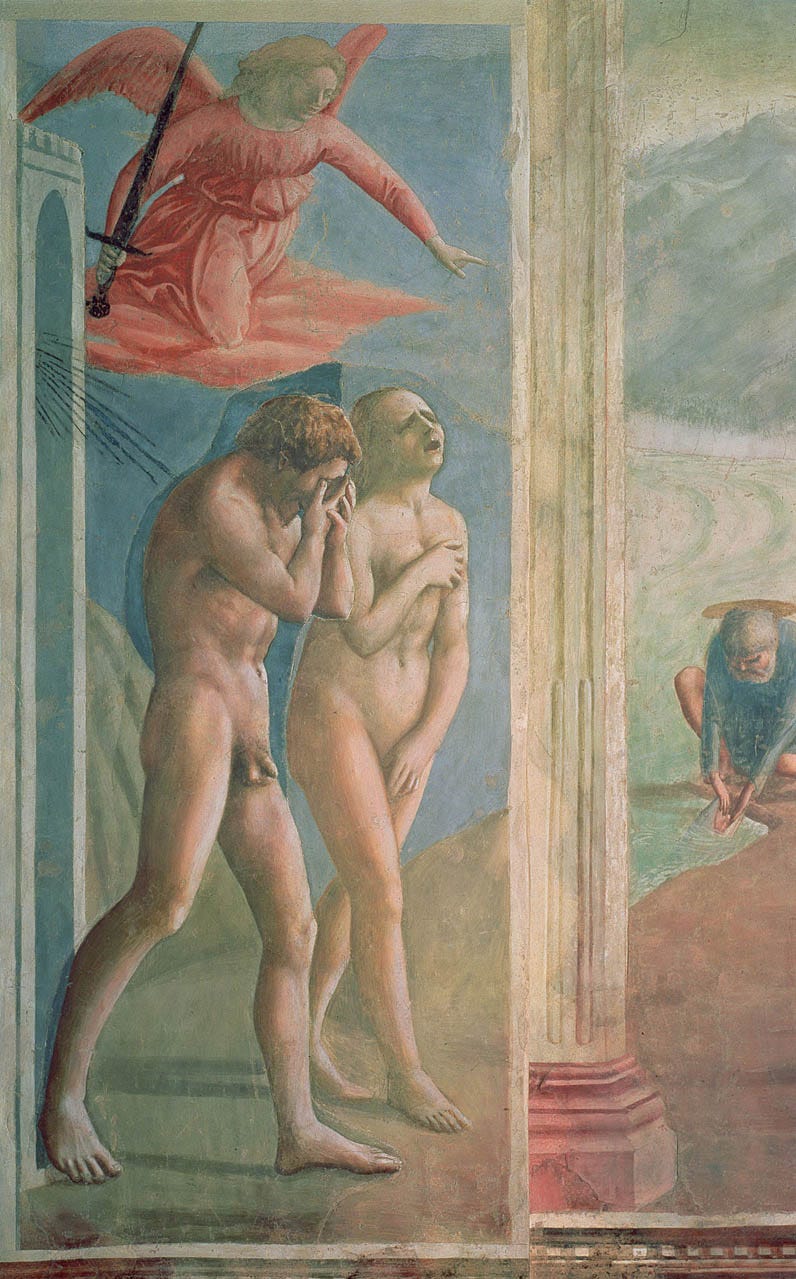
Adam and Eve Banished from Paradise
Artist / Origin: Masaccio (Italian, 1401–28)
Region: Europe
Date: ca. 1427
Period: 1400 CE – 1800 CE
Material: Fresco
Medium: Painting
Location: Brancacci Chapel, Santa Maria del Carmine, Florence, Italy
Credit: Courtesy of Bridgeman Art Library
Really appreciated this post. Was thinking yesterday about how far ahead we are in some things in society, yet have not addressed fundamental things holding us back, like how shame can be weaponised.
This is worth the re-read when I have a bit more time. A quick note..though. A random Adam&Eve tryptich in Paris..near Sacred Heart ..was so compelling...sexy..if you can say that about religious art...you couldn't help but realise..humans discovered the key to happiness. Men& Women creating their "Eden" with all the ups, downs and arounds that entails. Near Sacred Heart..Montmatre arrondissmont. Go see it..it will change your perspective..#TheWeddingatCana